 Skip to content
 Complete Mandala Guide Book: The Ultimate Handbook for Mandala History, Symbolism, Art & Techniques
Recent Blog


Mandalas have long been recognized…

Mandala art has quietly become…
If life feels like a thousand tabs open in your brain, a mandala is a gentle invitation to close a few of them. A mandala is, at its heart, a circle—often symmetrical, often patterned, sometimes wildly imaginative—designed to draw your attention inward. You don’t need to be an artist to work with mandalas. You only need a willingness to slow down, breathe, and let the act of creating become the point.
This is the philosophy behind Lico’s Collection: peace isn’t something you force into existence by trying harder—it’s something you allow, patiently and lovingly, one breath or one colored line at a time. In this blog, we’ll explore what mandalas are, where they come from, why they’re so calming, and how you can turn them into a simple, repeatable mindfulness practice—whether you’re coloring with a toddler, unwinding after work, or sharing a quiet hour with a grandparent.
What Is a Mandala, Really?
The word “mandala” is often translated as “circle,” but the meaning goes deeper than geometry. A mandala is a visual map of wholeness: a design that radiates from a center point, using repetition, symmetry, and balance to create a sense of order. Some mandalas are spiritual symbols. Others are purely decorative. Some are tightly structured; others look like blooming flowers, starbursts, or layered worlds.
What they share is this: mandalas guide the eye (and the mind) toward the center, then outward again, again and again. That movement mirrors what mindfulness asks of us: return to the present moment, notice what’s here, and begin again without judgment.
You’ll find mandala-like patterns across cultures: temple floors and sacred diagrams, quilt patterns and folk motifs, and even stained-glass rose windows in cathedrals. Lico’s Collection often speaks about growing up surrounded by architecture, travel, and symbolism, spaces where circles, repetition, and silence quietly teach the mind what “centered” feels like.
Why Mandalas Feel So Calming
Mandalas have a unique ability to quiet mental noise because they give the brain something simple and absorbing to do:
- They offer structure: Even when the design is complex, the symmetry creates a predictable rhythm.
- They invite focus: Coloring or drawing small repeating shapes keeps attention anchored.
- They create flow: When you’re immersed in choosing colors and filling shapes, worries tend to soften at the edges.
- They support emotional expression: Colors can reflect mood without needing words.
One of the most important shifts in mindful mandala practice is moving from “How will this look?” to “How does this feel while I’m making it?” Lico’s Collection builds on that idea throughout his work: focus on process, not perfection. When the process is the goal, the nervous system relaxes and creativity comes back online.
A Brief History of Mandalas
In Hindu and Buddhist traditions, mandalas can represent the universe, spiritual teachings, or stages of meditation. Some are used as tools for contemplation; gazing at a mandala can be a practice in concentration and inner stillness. Tibetan sand mandalas are famously created with extraordinary detail and then swept away, a reminder that beauty and effort can exist without clinging to a permanent outcome.
Circular sacred art also shows up elsewhere, including cathedral rose windows and many folk traditions that use circles to represent cycles—seasons, life stages, and the turning of time.
Seen this way, mandalas are not “one culture’s pattern.” They are a human way of saying: there is a center, there is a cycle, and there is wholeness.
Mandala Art as a Mindfulness Practice
Mindfulness is often described as paying attention on purpose, in the present moment, without judging what you find. Mandala art supports this because the steps are small, repeatable, and sensory.
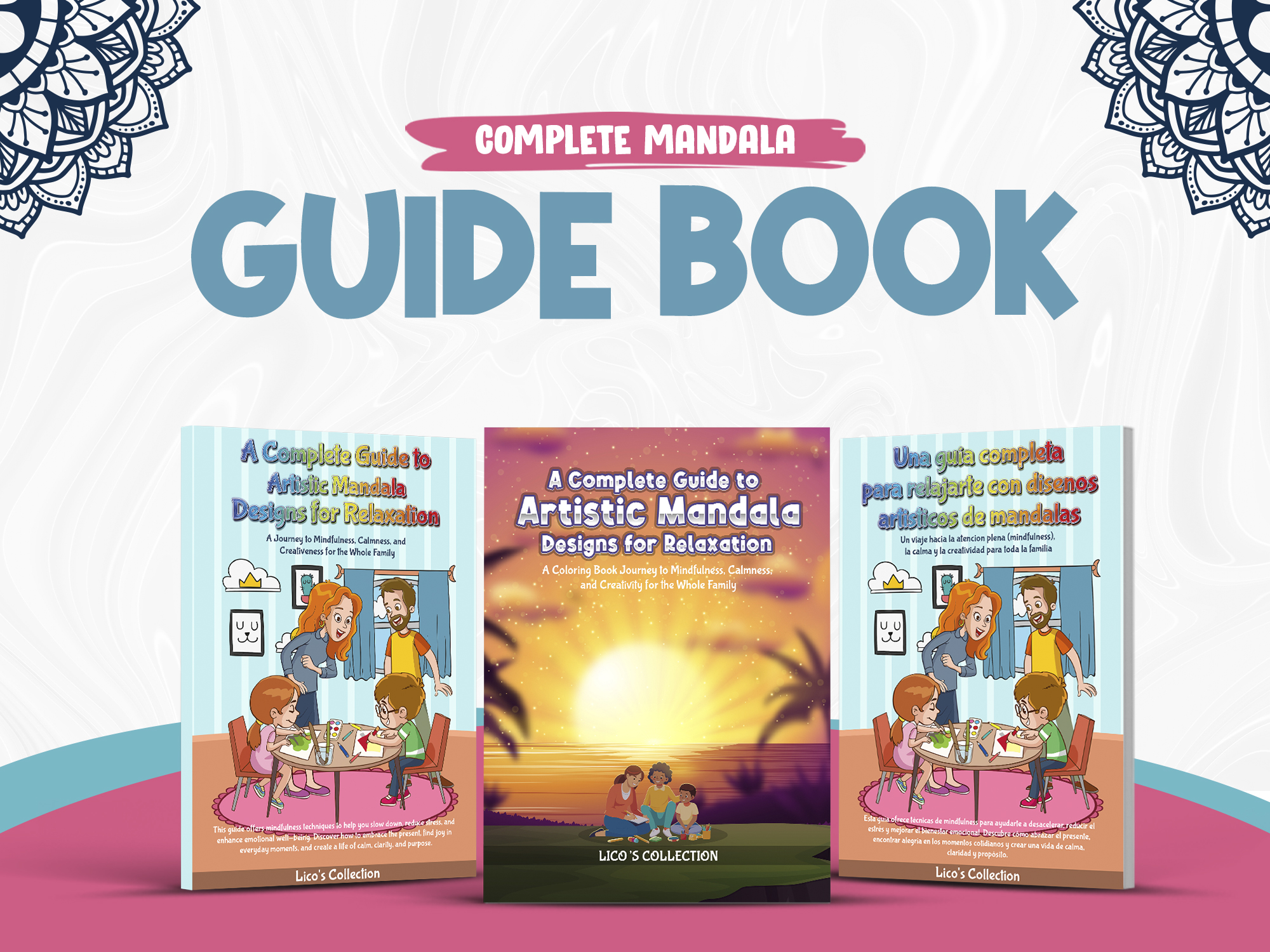
Try this simple mandala mindfulness routine inspired by Lico’s Collection guidebook, A Complete Guide to Artistic Mandala Designs for Relaxation: A Journey to Mindfulness, Calmness, and Creativeness for the Whole Family:
1) Set a small intention
Choose one word: calm, clarity, patience, gratitude, courage. Let that word be your “center.”
2) Breathe before you begin
Take three slow breaths. On the exhale, soften your shoulders and jaw.
3) Color or draw one small section at a time
Stay with the sensation: pencil against paper, pressure, texture, sound.
4) Pair breath with movement
Inhale as you begin a line or fill a shape; exhale as you complete it. If you like structure, use box breathing: inhale for 4, hold for 4, exhale for 4, hold for 4—then repeat.
5) End with one reflection
Ask: What changed in my body? What emotion showed up? What color felt most supportive today?
This is where Lico’s Collection’s approach stands out: mandalas are not just pages to complete, they are moments to live within. For more information on it, please see our blog “Online Mandala Design Coloring Book: Instantly Access Beautiful Digital Mandalas You Can Color Anywhere.”
Drawing vs. Coloring
Some people love drawing mandalas from scratch. Others find immediate relief in coloring ready-made designs. Both are valid—and both can become mindful.
- Drawing a mandala supports creativity, patience, and problem-solving. You’re deciding structure and pattern, so the mind feels engaged.
- Coloring a mandala supports relaxation and restoration. The structure already exists; you can simply step into it.
If you’re new, start with coloring. As confidence grows, experiment with simple mandala drawing: begin with a dot, draw a circle, add evenly spaced lines like a clock face, then build repeating shapes outward. You’ll be surprised how quickly “I can’t draw” turns into “I made this.” For this purpose, Lico’s Collection books can be a good start for you.
Tools, Techniques, and Color Choices That Make a Difference
You don’t need fancy supplies. But the right tools can make the experience smoother and more enjoyable:
Colored pencils
Great for beginners, gentle blending, and detail. Perfect for slow, calming sessions.
Markers
Bold, satisfying coverage. Better for larger areas. (Test for bleed-through if paper is thin.)
Now add a few simple techniques:
- Layering: build color gradually instead of pressing hard at the start.
- Blending: transition from one color to another for depth and softness.
- Gradients: shift from light to dark to create a glow effect.
- Texture: short strokes for fur, gentle dots for softness, cross-hatching for shadow.
And when stress is high, choose calming color families: soft blues and greens, gentle neutrals, or pastel tones. When energy is low, add warm accents—peach, coral, gold—to bring life back into the page.
Mandalas for Every Age (Yes, Really)
One reason mandalas work so well is that they scale. The same concept—repetition + focus + color—can meet people where they are.
Toddlers
Use large, simple shapes. The goal isn’t staying inside lines; it’s exploring color and movement. Keep sessions short and playful.
Kids and teens
Offer more intricate designs as attention grows. Mandalas become a quiet refuge from pressure, and collaborative projects (like one big page everyone colors) can add connection without forcing conversation.
Adults and seniors
Use mandalas as a decompression and routine. Even ten minutes can feel like a reset, and shared coloring time can be wonderfully social.
Lico’s Collection intentionally designs his work for this all-ages experience, because mindfulness gets stronger when it’s shared, not siloed.
Turn Mandalas Into a Weekly Ritual (The Family Method)
One of the simplest ways to make mandalas “stick” is to turn them into a ritual instead of a random activity.
Try a weekly mandala night:
- Choose a consistent day and time (even 30 minutes).
- Set up a “calm corner”: good light, comfortable seats, supplies ready.
- Start with 60 seconds of quiet breathing.
- Color together—no phones, no multitasking.
- End with a quick share: “What did you enjoy? What was hard? What color surprised you?”
Add themed nights when you want more fun—nature night, animals night, geometric night. You can even pair coloring with storytelling: write a few lines about what the mandala represents, or journal a quick “before and after” mood check.
Mindful Journaling With Mandalas
If you want mandala practice to go deeper, combine it with journaling. This doesn’t need to be long or intense. A “mindful coloring journal” can be as simple as:
- a photo of your finished page,
- three words describing your mood,
- one sentence: “Today I needed…”
- one gratitude,
- one intention for tomorrow.
Over time, you’ll notice patterns: colors you reach for when you’re anxious, shapes that feel soothing, and the way your nervous system settles faster with practice. This is mindfulness made visible. For further relevant information on mandalas, you can have a look at our blog “Mandala Patterns Coloring Book: Stunning Intricate Designs That Bring Focus, Peace & Creativity Alive.”
How Lico’s Collection’s Books Work Together
Think of these books as two complementary paths into the same circle of calm:
1) A Complete Guide to Artistic Mandala Designs for Relaxation: A Journey to Mindfulness, Calmness, and Creativeness for the Whole Family
A Complete Guide to Artistic Mandala Designs for Relaxation: A Journey to Mindfulness, Calmness, and Creativeness for the Whole Family is designed like a roadmap. It introduces mindful art foundations, offers age-appropriate exercises, teaches practical techniques (like layering, blending, and breathwork), and shows how to build weekly rituals and reflection prompts. If you like knowing the purpose behind what you’re doing, this is your anchor.
If you’ve been searching online for a complete mandala guide book that feels welcoming, practical, and family-friendly, this is the one to start with.
2) A Complete Guide to Artistic Mandala Designs for Relaxation: A Coloring Book Journey to Mindfulness, Calmness, and Creativity for the Whole Family
This book is for doing. With 100+ designs, varied themes (animals, nature, geometric patterns, and more), and thoughtful design choices like quality paper and detachable sheets, it makes it easy to sit down and begin—no planning required.
If you want a screen-free calm-down tool that works for solo sessions, classrooms, and family tables, this one becomes your go-to.
A Simple 7-Day Mandala Reset Plan (Use With Either Book)
Day 1: Choose one mandala. Color for 10 minutes. Stop even if it’s unfinished. Practice “process over product.”
Day 2: Add breathing: inhale for 4, exhale for four while coloring.
Day 3: Try a calming palette (blues/greens/soft neutrals).
Day 4: Journal three lines: “I noticed… I felt… I’m grateful for…”
Day 5: Practice blending or layering in one small area.
Day 6: Share with someone—color side by side, or show them what you made.
Day 7: Create a ritual: pick your weekly mandala time for the next month.
This is exactly the kind of gentle consistency Lico’s Collection champions: inner peace isn’t somewhere you travel, it’s something you create, patiently, in small repeatable moments.
Choosing the Right Mandala Book for Your Style
People search for different things because they want different outcomes. Here’s a simple way to match intention to book:
- If you want instruction, techniques, and a full mindfulness framework, you’re looking for the best complete guide book about mandala art. Start with the guide.
- If you want a practical step-by-step approach that supports both learning and creativity, the guide also fits what many call a complete mandala art guide book for beginners & artists.
- If your main goal is to learn structure, pattern-building, and design thinking, you’ll be drawn to a complete guidebook for mandala drawing & design—again, the guide is the best foundation.
- If you’re brand new and want an easy entry point, you may have typed mandala beginner books. The guide teaches the “why,” while the coloring book gives you instant practice.
Conclusion
The mandala has existed since the fourth century, although its popularity has increased due to the proliferation of online mandala coloring books for adults and kids. Mandalas are a religious and ceremonial symbol of Buddhism, and they are mostly made in Tibet, India, Nepal, China, and Japan.
Making mandalas has long been considered a type of healing art. The repeating patterns mimic nature, whether you color one in or make one yourself. It is referred to as “oneness with the universe” by Buddhists. They promote harmony, lessen tension, and stimulate originality.
That’s why mandalas have lasted across centuries and cultures. And that’s why Lico’s Collection’s work connects: it turns the simple act of coloring into a doorway back to yourself and the people you love.
